
My writing process
CC 215 — The messy way I develop City Conversations

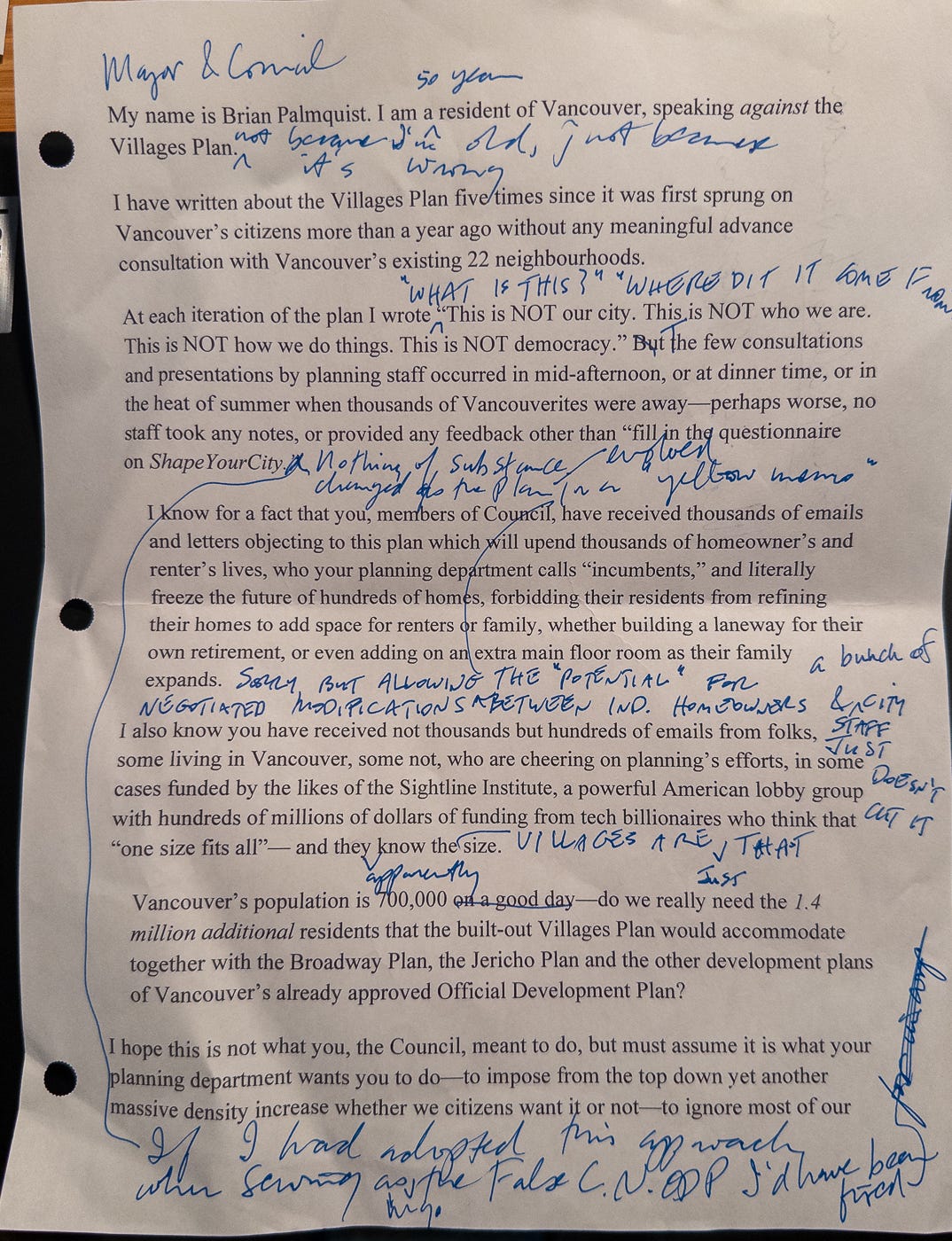
Page 1 of 2 of my remarks to Council about the Villages Plan, July 14, 2026
I need a break from the Villages Plan, which I’ve written about five times in City Conversations since it was sprung on Vancouverites about a year ago. I’m lucky—as speaker #15 on Tuesday, my presentation to Council is done, but I hope the 200+ other folks who’ve signed up to speak at the next part of the Public Hearing (July 20, 1pm) carry on and have their say. So I’m writing about how I write.
I just realized that this is CC #215, written more than five years since my first CC—and there are about 215 more speakers about the Villages. Just wow!
The rumpled page above is the first of my two pages of remarks to Council. It illustrates how I approach writing for public consumption. There may be a few lessons for those yet to speak.
I am neither natural speaker, nor journalist, nor writer. I did take a few creative writing courses at UBC, which were free due to by advanced age. My journalism cred is just about zero as I am shy about interviewing folks. I write out my remarks and rehearse them, to ensure I don’t transgress Council’s arbitrary 5-minute time limit (was only 3 minutes until recently), which the Mayor or designate are brutal about enforcing.
My own writing process kinda works like this:
Ruminate about the local events of the day that I can intelligently write about—I am an architect and urban designer, so mostly limit myself to those subjects. I have opinions about many subjects, but limit my writing to where I have some experience and expertise.
Search for a title—I like alliteration and historical references, so “Are we the Village Idiots?”, “Is that all there is?”, “Rush to misjudgment,” etc. I am often away from a keyboard when ideas come to me, so I keep them on a Reminders list on my iPhone. I currently have 295 possible titles. Depressing.
Use Substack’s subtitle capability—Subtitles show up below titles on Substack’s cover art, so a second chance to elaborate, or in my case, to explain my sometimes impenetrable titles.
Always start with a thoughtful illustration—Substack will front and centre a photo, map or similar illustration and we know folks like pictures. I mostly use my own photos, so no credit required. If you do use someone else’s image, ask permission and give credit. When using an illustration from a public document such as the Villages Plan, footnote the document URL and the page number.
Write away and edit ruthlessly—Often my first drafts are well over 1,000 words. I then look for repetition, side tracks or other embellishment and take them out. I don’t keep track of how many edits I do, but at a guess, at least six drafts. CC#214 ended up at 711 words, so I knew I had some slack—which I filled in with blue ink while awaiting my turn to speak!
Write for space and time—When I am writing specifically for publication, I try to stay below 800 words, which editors like. That also works out to about five minutes reading, which is Vancouver Council’s time limit. When I’m to speak to Council I always rehearse against a stopwatch, then edit again. After many edits my Villages remarks were still a minute over, so I took out even more.
Fill in as events unfold—All of the blue ink in the above illustration arose while I was awaiting my turn to speak—thoughts intruded as I listened to others and as I continued to rehearse in my mind. Because I had edited down to about 4 minutes speaking time, I could add the blue notes back—I finished at 4-3/4 minutes.
As the remaining 200+ of you think about what you will say about the Villages Plan when your moment comes, good luck. I hope my experience may be of help—all 663 words of it!
If you feel the Villages Plan is a gross overreach by city staff and government, my suggestion:
Sign up to speak at the Public Hearing round 2 scheduled July 20th starting at 1pm—details are in my previous City Conversation. It’s still not too late!
This post is 663 words—somewhat less than a 5 minute talk. If you appreciated this post, please share to your social media and consider becoming a free subscriber to City Conversations at
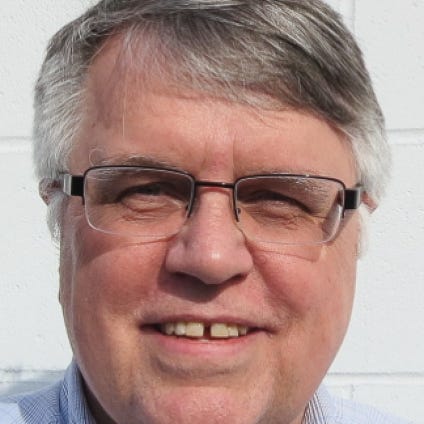
Brian Palmquist writes in the ancestral lands of the Musqueam people. He is a Vancouver-based architect, building envelope and building code consultant and LEED Accredited Professional (the first green building system). He is semi-retired, still teaching, writing and consulting a bit, but not beholden to any client or city hall. City Conversations mix real discussion with research and observations based on a 50-year career including the planning, design and construction of almost every type and scale of project. He is the author of the Amazon best seller and AIBC Construction Administration course text, “An Architect’s Guide to Construction.” A glutton for punishment, he is threatening to write a book about how we can Embrace, Enhance and Evolve the places where we love to live. Some of its content may appear above.
Gratefully noting
Here is the url to sign up for next part of the Public Hearing
(July 20, 2026 at 1pm)
https://app.vancouver.ca/councilMeetingPublic/
Larger cities like London have villages within them - a few commercial streets surrounded by residences. Residents are close to local shops. They walk or use bus/subway transportation. Fewer cars. Sounds reasonable to me. I live in the West End, my own village. Love it. People are so resistant to change, unfortunately. Everything changes.